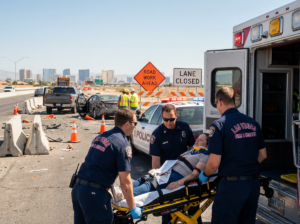
Construction zones are everywhere in and around Las Vegas—and they’re one of the most common places we see “normal” drives turn into sudden, high-impact crashes.
Why? Because work zones combine changed road conditions (lane shifts, closures, uneven pavement) with unpredictable driver behavior (distraction, impatience, and risky merges). Here are the biggest hazards to watch for.
1) Distracted drivers in a place that demands focus
A work zone is an area of a roadway where construction, maintenance, or utility work is happening, often with temporary traffic control like cones, barrels, and signage. These areas are inherently higher-risk for both workers and drivers because conditions change and space is limited.
When another driver is looking at a phone, eating, or simply not scanning ahead, the results in a work zone can be immediateSudden rear-end collisions when traffic slows
- Side-swipes when lanes narrow
- Multi-car chain reactions because there’s less room to recover
2) The “squeeze-in” pass and last-second merge
One of the most dangerous behaviors in construction traffic is the driver who tries to race forward and force a merge at the last second.
In a normal lane change, you have shoulder space and predictable lane lines. In a work zone, you often have:
- Barriers close to the travel lane
- Narrow lanes with little margin for error
- Drivers braking hard to avoid missing a closure
That “I’ll just squeeze in” move can cause a collision even if you’re driving responsibly—because you may get hit, pushed, or forced into a barrier with nowhere to go.
3) Lane shifts, crossovers, and closed lanes (sometimes with confusing markings)
Work zones frequently involve temporary traffic control that reroutes vehicles around the work area. That can mean:
- Lanes shifting left or right
- Temporary striping that’s hard to see at night or in glare
- A lane that was open yesterday being closed today
The Federal Highway Administration’s MUTCD (the national standard for traffic control devices) includes guidance for temporary traffic control in work zones—because consistent, visible direction is critical when drivers are navigating sudden changes.
Even with good signage, drivers who are on “autopilot” (especially on familiar routes) are more likely to drift, overcorrect, or miss a merge.
4) Debris, loose materials, and uneven road surfaces
Construction work can leave hazards on the roadway, including:
- Loose gravel or dirt
- Small debris (plastic, metal fragments)
- Uneven pavement edges or bumps
Debris is dangerous for two reasons:
- It can cause tire damage or loss of traction.
- It triggers panic reactions—drivers swerve abruptly instead of slowing down and maintaining control.
5) Work vehicles and workers close to traffic
Work zones may include slow-moving trucks entering/exiting the roadway, equipment positioned near travel lanes, and workers just feet from passing traffic. That’s one reason work zones are dangerous not only for motorists, but also for the people doing the work.
Practical safety moves that actually help
If you want the short list of what reduces risk the most:
- Slow down early and follow posted work-zone speeds
- Increase following distance (you need extra room for sudden stops)
- Avoid unnecessary lane changes
- Signal early and merge smoothly—don’t “race the merge”
- Watch for lane shifts and temporary markings
- If you see debris, don’t swerve blindly—slow down and keep control
If a construction-zone crash happens anyway
If you’re involved in a collision, prioritize safety first: call 911 if anyone may be injured, get medical attention, and document what you can. Work-zone details can matter later—photos of lane shifts, signage, barriers, and debris can help preserve what the scene looked like.
If you have questions after a crash, the personal injury experts at Cap & Kudler are here for you – Call us at 702-878-8778.
Disclaimer: This blog post is provided for general informational purposes only and is not legal advice. Reading this post does not create an attorney-client relationship. Every accident and injury claim is different, and the laws that apply depend on the specific facts of your situation. For advice about your particular circumstances, consult a qualified attorney licensed in your state. If you need immediate help, call 911 or seek medical attention right away.
- Sources:
CDC/NIOSH, Highway Work Zone Safety (overview and definition of work zones): https://www.cdc.gov/niosh/motor-vehicle/highway/index.html - Federal Highway Administration (FHWA), Manual on Uniform Traffic Control Devices (MUTCD), Part 6: Temporary Traffic Control (national standards for temporary traffic control in work zones): https://mutcd.fhwa.dot.gov/pdfs/2009r1r2/part6.pdf