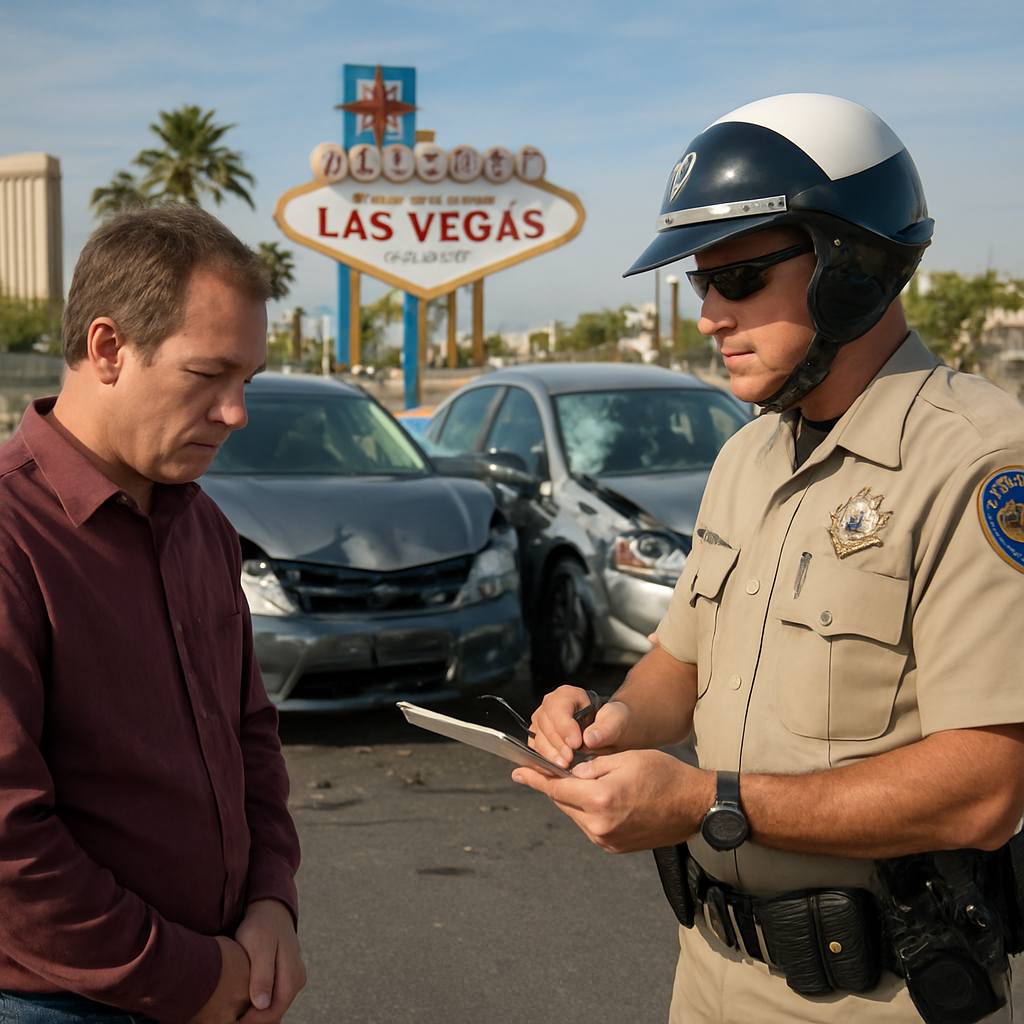
 If you’ve been in a crash, it’s normal to wonder: Does a traffic ticket decide who’s at fault? Not always—but it can matter a lot.
In Nevada injury cases, a citation can become powerful evidence when it lines up with a legal concept called negligence per se. In plain English, that means a person can be considered negligent because they violated a safety law that was designed to prevent the kind of harm that happened.
A ticket is not the same thing as civil liability
First, a key distinction:
- A traffic ticket is part of a traffic court process.
- Liability for injuries is decided in a civil case, where the injured person must prove fault and damages.
So even if someone gets cited, the insurance company (and later a civil jury) can still argue about what really caused the collision.
That said, a ticket can shift the conversation—especially if it leads to a court finding that a driver violated a law.
What “negligence per se” means (in everyday terms)
Normally, proving negligence requires showing someone failed to act with reasonable care.
Negligence per se is different. Nevada courts have explained that a violation of a statute can constitute negligence per se when:
- The injured person belongs to the class of individuals the statute was intended to protect, and
- The injury suffered is the type the statute was intended to prevent.
This framework is discussed in Nevada cases including Gordon v. Hurtado and Vega v. Eastern Courtyard Associates.
How a traffic ticket can support a negligence per se argument
A ticket by itself is often just an allegation. But if the driver:
- Pleads guilty, or
- Is found guilty after a hearing/trial, or
- Otherwise has a court determination that they violated a law,
that outcome can become meaningful evidence in the injury case.
Why? Because traffic statutes are safety rules designed to prevent collisions. If a court finds a driver violated one of those rules—and that violation caused the crash—the injured person may argue that the violation establishes negligence under a negligence per se theory.
Example
Imagine a driver is cited for running a red light. If the evidence shows the red-light violation caused the collision, the injured person may argue negligence per se because the traffic law is designed to prevent intersection crashes.
A key limitation: the judge decides whether negligence per se applies
One important point from Nevada law: even if there’s a violation, whether a particular statute, regulation, or ordinance is used to define the standard of care is a question of law for the court.
In Vega v. Eastern Courtyard Associates, the Nevada Supreme Court explained that while a building code provision adopted by local ordinance may support negligence per se if the two factors are met, the decision to use that law to define the standard of care is for the judge.
In a car accident case, that means negligence per se isn’t automatic just because there’s a ticket. The court still has to decide whether the cited law is the right kind of safety rule to use as the standard of care for the civil claim.
Negligence per se doesn’t automatically end the case
Even when negligence per se is in play, the defense may still argue issues like:
- Causation: “Yes, there was a violation, but it didn’t cause this crash.”
- Comparative fault: “The other driver also contributed.” Nevada uses modified comparative negligence rules.
- Damages: “The injuries aren’t as serious as claimed,” or “the treatment wasn’t related.”
So, a ticket can be a major piece of the puzzle—but it’s rarely the whole puzzle.
Why this matters for insurance claims
Insurance adjusters look for leverage. A traffic citation (especially one that results in a conviction or clear admission) can:
- Strengthen the injured person’s demand,
- Reduce the insurer’s ability to argue “shared fault,” and
- Increase the likelihood of a fair settlement.
On the flip side, if you were ticketed, the insurer may try to use it to undervalue or deny your claim—even when the ticket doesn’t reflect what really happened.
What to do if you’re injured and a ticket was issued
A few practical steps that protect your case:
- Get the crash report and confirm what it actually says.
- Don’t assume the ticket decides fault. The facts still matter.
- Preserve evidence early: photos, video, witness info, and medical documentation.
- Be careful with statements to insurers before you understand how the citation may be used.
Bottom line
A traffic ticket can affect liability in a Nevada car accident case—especially when it leads to a court finding that a driver violated a safety law. Under a negligence per se theory, that violation may be treated as negligence when the law was meant to protect people like the injured person and prevent the type of harm that occurred, and when the violation caused the crash.
If you were injured in a car accident involving a traffic-law violation, call the personal injury lawyers at Cap & Kudler for a free consultation with an attorney.
Disclaimer
This article is for information only and is not legal advice.
Sources
· Atkinson v. MGM Grand Hotel, Inc., 120 Nev. 639, 641, 98 P.3d 678, 679 (2004)
· Gordon v. Hurtado, 96 Nev. 375, 609 P.2d 327 (1980)
· Vega v. Eastern Courtyard Associates, 117 Nev. 436, 24 P.3d 219 (Nev. 2001)
· Barnes v. Delta Lines Inc., 99 Nev. 688, 669 P.2d 709 (1983)
· Southern Pacific Co. v. Watkins, 53 Nev. 471, 435 P.2d 498 (1967)
· https://ag.nv.gov/uploadedFiles/agnvgov/Content/Issues/09292021_NV-Jury-Instructions-Civil-2018-PDF-version.pdf